































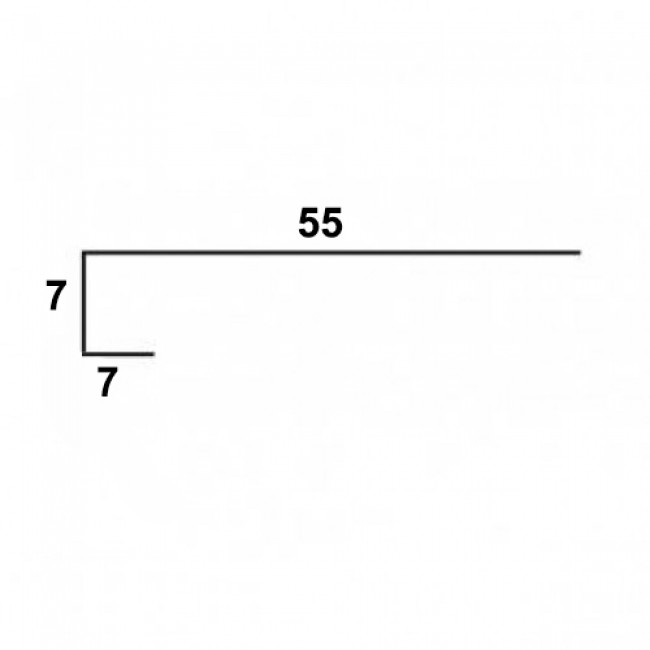
L-shaped Hook Anchor Ø8 mm, pointed
The L-shaped hook anchor Ø8 mm is a steel rod with a bent top — a horizontal arm and a hook. The hook grips the geocell wall, the edge of the geogrid or the wire of the mesh, while the long shaft goes deep into the soil and anchors the system.
Its shape makes it especially practical for stretching and fixing geocells before filling: the hook holds the cell open and stops the panels from collapsing while soil, gravel or concrete is placed.
How it works
The hook wraps the edge of the material, the horizontal arm takes the load from above and the shaft works in pull-out and shear in the soil. The anchor therefore holds the material down and stops it from sliding along the slope.
Technical specifications
| Type | L-shaped rod with hook |
| Rod diameter | Ø8 mm |
| Dimensions | shaft 55 cm, arm 7 cm, hook 7 cm |
| Tip | pointed tip |
| Material | steel rod |
| Intended for | geocells, geogrids, meshes and mats on slopes |
| Minimum order quantity | 50 pcs |
Applications
- Stretching and fixing geocells before filling
- Slopes, embankments and banks
- Rockfall and erosion meshes
- Geogrids for greening slopes
- Temporary fixing of geotextile
How to choose the diameter
- Ø6 mm – light materials: geotextile, erosion mats, meshes in soft soil.
- Ø8 mm – the most versatile size for geogrids, geonets and geocells on green areas and moderate slopes.
- Ø10 mm – heavier fill, steeper slopes, loose or made-up ground.
- Ø12 mm – high loads: riverbanks, road embankments, sites with running water.
The final choice depends on the soil, the gradient and the type of fill. If in doubt, call us — we will help you work out the size and number of anchors.
Pointed tip or straight end?
The anchors come in two versions. The pointed tip enters compacted, clay and stony soils more easily and reduces the risk of the rod bending while driven. The straight-end version is more economical and fully adequate for soft and medium soils, fills and topsoil. This product has a pointed tip.
Installation step by step
- Prepare and level the subgrade, remove large stones and roots.
- Lay the geotextile, mat or geocell and stretch it into its design position.
- Hook the anchor over the cell wall or the edge of the material.
- Drive the anchor fully home with a hammer until it sits tight against the material.
- Start at the top of the slope and work down. A typical spacing is 1–1.5 m, closer along the crest and at overlaps.
- Fill with soil, gravel or concrete and compact.
Frequently asked questions
How many anchors per square metre?
It depends on the gradient, the soil and the material. Flat ground needs fewer; steep slopes and waterside sites need more. Send us the area and gradient and we will give you a quantity.
Can it be driven into stony ground?
Yes, but we recommend a larger diameter and a pointed tip there. In very hard rock a pilot hole is drilled.
Can it be combined with other fasteners?
Yes. Longer anchors are often used along the crest of the slope and shorter, lighter ones across the area. We can suggest a combination for your project.
Related products
- Geocells – cellular confinement systems for slopes, paths and car parks
- Gabions – retaining walls and riverbank protection
- All fastening elements for geosystems
Why Smart Metal Group?
Smart Metal Group is a Bulgarian supplier of gabions, geosynthetics, fencing systems and fastening elements. We keep stock in our warehouse, help you choose the right product and calculate quantities, and arrange delivery to your site.
For advice, a volume quote or delivery times: +359 884 660 030 or sales@smartmetalgroup.com.
| Общи | |
| Дължина | 0 cm |
| Широчина | 0 cm |
| Височина | 0 cm |